
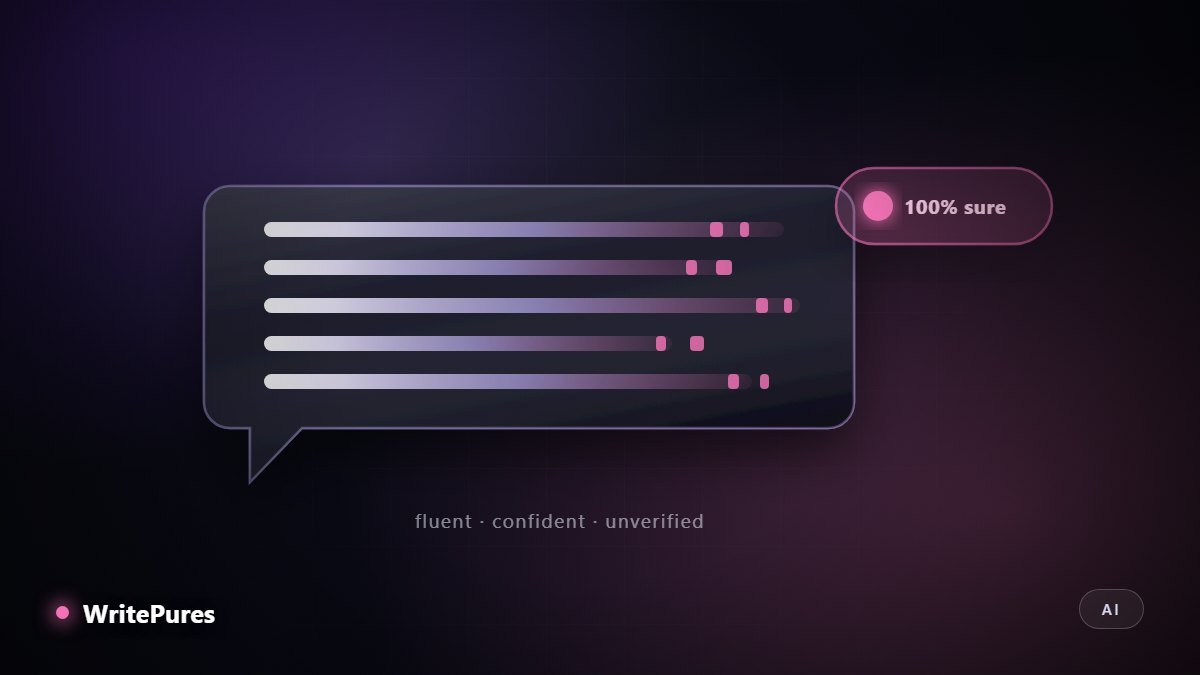
An AI assistant will answer a question about a law that does not exist, a function that was never written, or a study nobody published — in the same measured, authoritative tone it uses when it is right. Understanding why is the key to using these tools safely.
Why It Happens at All
A language model is not looking anything up. It is predicting what text should come next, one piece at a time, based on patterns learned from an enormous amount of writing. That single fact explains most of its behaviour.
When you ask something well covered in that training material, the most probable continuation is usually the true one, and the answer is right. When you ask something obscure, very recent, or simply non-existent, there is no well-worn path — but the model still produces the most plausible-looking continuation. Plausible and true are different targets, and only one of them is being optimised.
Three consequences follow:
- It rarely refuses by default. Producing an answer is the behaviour being modelled; "I don't know" is comparatively rare in written text.
- Confidence is stylistic. The assured tone comes from the writing it learned, not from any internal measure of certainty.
- Fabrications are well-formed. An invented citation has a plausible author, a plausible journal and a plausible year, because that is the shape of a real one.
Where Hallucination Concentrates
Errors are not evenly distributed. Knowing the high-risk zones tells you where to check.
| High risk | Lower risk |
|---|---|
| Citations, DOIs, case law, page numbers | Explaining a widely taught concept |
| Precise statistics and dates | Rewriting or summarising text you supplied |
| Recent events after the training cut-off | Brainstorming and generating options |
| Niche APIs, library functions, config flags | Common patterns in popular languages |
| Quotations attributed to real people | Structure and formatting tasks |
| Local regulations, fees, deadlines | Translation of ordinary prose |
The pattern is consistent: specific, verifiable, low-frequency details are where invention happens. General explanation is comparatively safe. This is also why a single wrong number inside an otherwise excellent answer is the characteristic failure, rather than an entirely wrong response.
Checks That Actually Work
- Verify the citation, do not admire it. Search the exact title. An invented reference evaporates the moment you look for it — and the presence of a citation is not evidence that it exists.
- Ask the same question in a fresh conversation. Genuine knowledge tends to be reproduced consistently; invention often varies between attempts. Differing specifics across runs is a strong warning sign.
- Request the reasoning, then check the steps. Errors are frequently visible in the working even when the conclusion looks reasonable.
- Give the model the source material. Pasting the document and asking it to answer only from that text is dramatically more reliable than asking from memory. Our guide to retrieval-augmented generation covers how this works at scale.
- Make not knowing an acceptable answer. Explicitly permitting "the document does not say" measurably reduces invention, because it offers a path other than producing something.
- Run the code. For programming, execution is the check. A function that does not exist fails immediately — which is why code is among the safer uses despite frequent errors.
- Apply domain judgement. If you cannot evaluate the answer at all, that is exactly the situation in which you should not act on it unverified.
Prompting that reduces it
Phrasing changes outcomes more than most people expect. Asking "what are the arguments for and against X" invites a balanced treatment; asking "why is X the best approach" presupposes the conclusion and invites supporting invention. Supplying context rather than requesting recall shifts the task from remembering to reading. Our prompt engineering guide goes through this in more detail.
Building It Into How You Work
For individuals, one rule covers most situations: use AI for things you can check, and check them. Treat every output as a draft from a capable but unreliable colleague.
For teams putting these tools in front of customers, a few practices matter:
- Ground answers in your own content and show the source alongside the answer.
- Keep a human in the loop wherever an error carries real cost — money, health, legal standing, safety.
- Log inputs and outputs so errors can be investigated rather than merely reported.
- Test on your own real queries, not on public benchmarks, which rarely resemble your traffic.
- Tell users plainly that answers are AI-generated and may be wrong. It is both honest and increasingly expected by regulators.
Key Takeaways
- Models predict plausible text; truth is a frequent by-product, not the objective.
- Confidence in the tone carries no information about accuracy.
- Errors cluster in citations, figures, dates, niche APIs and local rules.
- Supplying source material and permitting "I don't know" both reduce invention substantially.
- Use AI where verification is cheap — and actually verify, rather than trusting fluency.
Written by the WritePures newsroom. Spotted something that needs updating? Tell our editors.




0 Comments
Join the conversation
Replying toNo comments yet. Be the first to share your thoughts.