
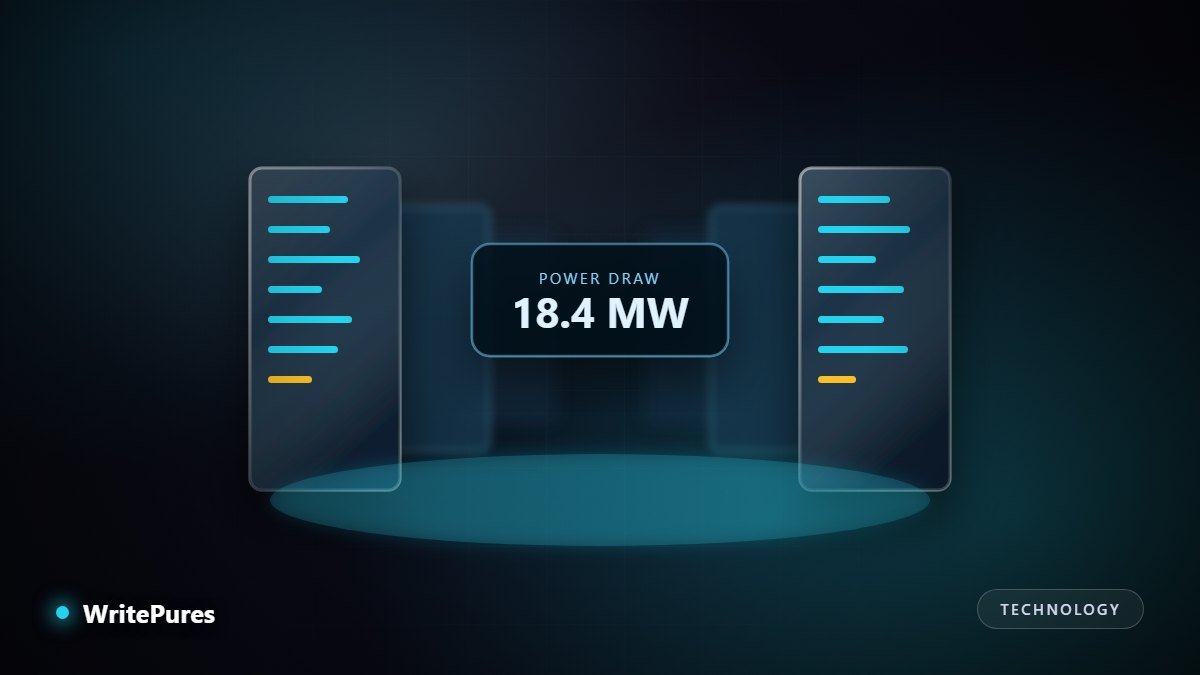
Every cloud service, video stream and chatbot reply is a physical event in a building somewhere — electricity entering, heat leaving. Understanding where that power goes explains most of what is currently being argued about in technology and energy policy.
What Is Actually Inside One
A data centre is a building designed around two problems: delivering reliable electricity, and removing the heat that electricity becomes. Everything else follows from those.
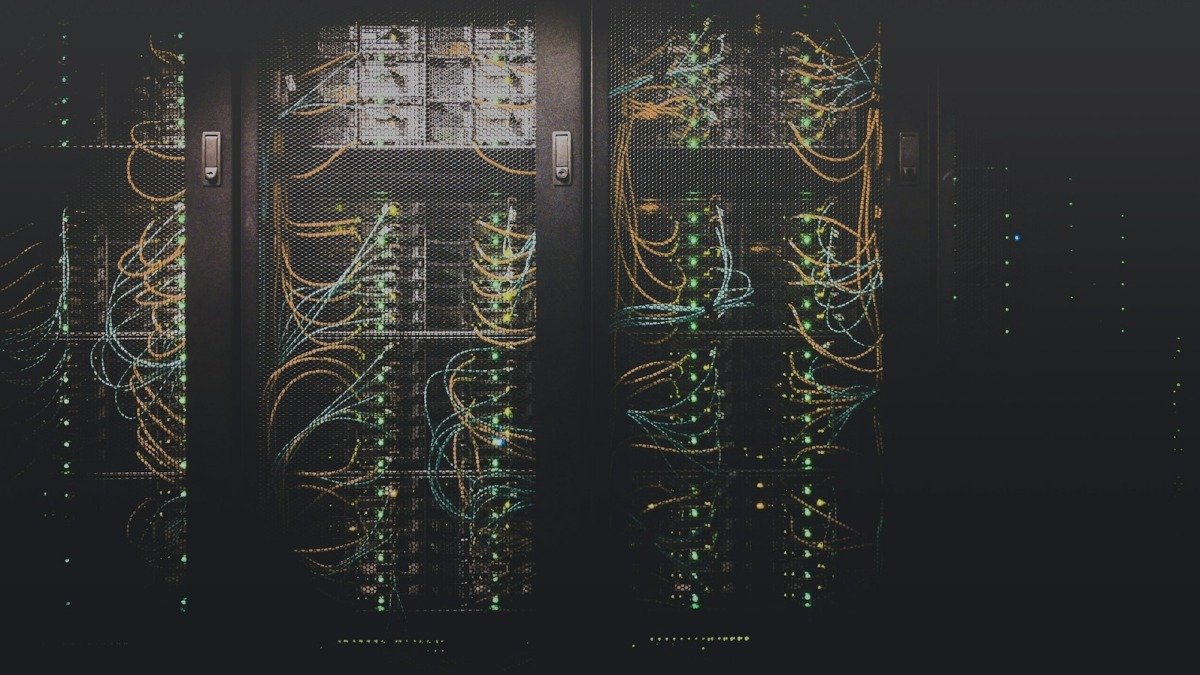
- The data hall — rows of racks holding servers, storage and network equipment, arranged in alternating cold and hot aisles so intake and exhaust air never mix.
- Power infrastructure — utility feeds, transformers, switchgear, uninterruptible power supplies that carry the load for the seconds before generators start, and the generators themselves with on-site fuel.
- Cooling plant — chillers, air handlers, cooling towers, and increasingly liquid loops carrying heat directly away from chips.
- Network connectivity — diverse fibre routes entering the building at separate physical points, so one excavator cannot disconnect the facility.
- Security and fire systems — layered physical access control and suppression designed not to destroy the equipment it protects.
The design philosophy throughout is no single point of failure. Two of everything, on independent paths, is what separates a data centre from a large server room — and it is the main reason they are expensive.
Where the Electricity Goes
Roughly speaking, power divides into three buckets.
| Consumer | Share of total | Notes |
|---|---|---|
| IT equipment | Majority | Servers, storage, networking — the useful work |
| Cooling | The largest overhead | Varies enormously with climate and design |
| Power conversion and distribution losses | Smaller but constant | UPS, transformers, cabling |
| Lighting, security, offices | Minor | Negligible in a large facility |
This is what PUE measures: total facility power divided by IT power. It captures overhead efficiency and nothing else. A facility can have excellent PUE while consuming enormous absolute power from a coal-heavy grid, which is why PUE alone is a poor environmental claim.
An important nuance about efficiency
Servers are most efficient per unit of work when heavily utilised. An idle server still draws a substantial share of its peak power while producing nothing. This is the strongest argument for cloud consolidation: one well-utilised machine serving many tenants wastes far less than many lightly-loaded private servers. The same logic underpins the cost arguments in our guide to cutting cloud costs.
How Cooling Actually Works
- Air cooling with hot and cold aisle containment. The long-standing default: cold air to the front of the racks, hot exhaust captured behind and returned to the cooling plant without mixing.
- Free cooling. Where the outside air or water is cold enough, chillers can be bypassed for much of the year. This is the single largest efficiency win available, and it is why climate affects siting so strongly.
- Evaporative cooling. Water evaporation removes heat very efficiently, trading electricity for water consumption — a trade that is uncontroversial in some regions and deeply contested in others.
- Liquid cooling. Coolant carried directly to a cold plate on the chip, or whole systems immersed in dielectric fluid. More complex, and increasingly unavoidable as rack density rises.
Why AI Changed the Arithmetic
The shift is not simply "more computers". It is power density. A conventional rack of web servers might draw a handful of kilowatts. Racks packed with accelerators draw many times that in the same floor space, and air struggles to carry that much heat away at all.
The knock-on effects reshape the whole building and its surroundings:
- Liquid cooling moves from exotic to standard.
- Electrical distribution, floor loading and structural design all change.
- Site selection becomes dominated by available grid capacity, which is now a harder constraint than land or construction cost in many regions.
- Grid connection queues stretch for years, which is why large operators increasingly contract generation directly rather than waiting.
Training and inference also behave differently. Training is a large, schedulable job that can be moved to where and when power is cheapest. Inference must happen when users ask, close enough to them to feel responsive — a very different siting problem.
Reading the Claims Critically
Three distinctions make announcements easier to evaluate:
- Efficiency is not consumption. A more efficient facility can still increase total demand, and usually does.
- "100% renewable" usually means annual matching — buying as many clean megawatt-hours over a year as were consumed, not running on clean power at every hour. Hourly matching is a far stronger claim and is rarer.
- Water and carbon can trade against each other. Reducing one often raises the other, so a single headline figure rarely tells the whole story.
Key Takeaways
- A data centre is organised around delivering reliable power and removing heat; redundancy explains its cost.
- Cooling is the largest overhead, and climate-enabled free cooling is the biggest efficiency win.
- PUE measures overhead only — not total consumption, and not how clean the power is.
- AI raised power density per rack, pushing the industry toward liquid cooling and grid-constrained siting.
- Treat "efficient" and "100% renewable" as claims to interrogate, not conclusions.
Written by the WritePures newsroom. Spotted something that needs updating? Tell our editors.

0 Comments
Join the conversation
Replying toNo comments yet. Be the first to share your thoughts.